
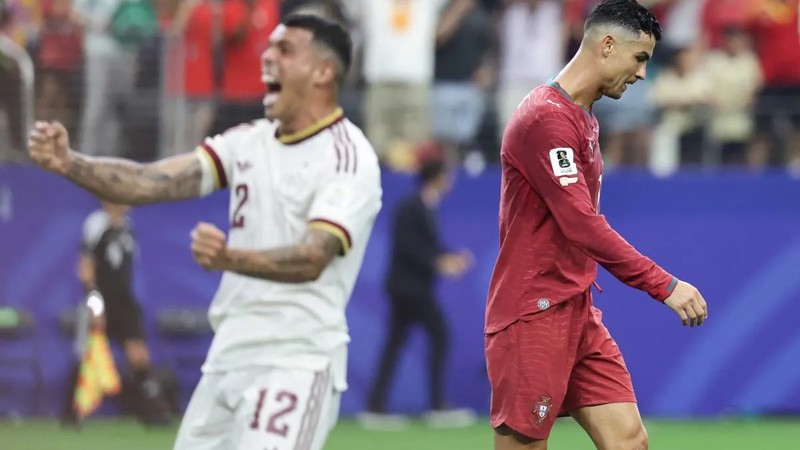
Cristiano Ronaldo had told the world this was his last dance. He said it plainly, on the eve of the match, with the quiet certainty of a man who has nothing left to prove. On Monday night in Dallas, that dance ended without music — without even a goal — as Arsenal midfielder Mikel Merino ghosted off the bench in the 85th minute and broke Portuguese hearts with a composed finish in the first minute of injury time.
Spain win 1-0. Ronaldo is done. And La Roja march into the quarter-finals of the 2026 World Cup for the first time since lifting the trophy in South Africa sixteen years ago.
The setting was suitably grand: 70,649 spectators packed into the air-conditioned home of the Dallas Cowboys, watching two Iberian neighbours — both unbeaten coming in, both with genuine ambitions — contest what had been billed as one of the last-16’s marquee fixtures. On paper, it promised fireworks. In reality, it delivered something far more familiar to anyone who has watched tournament football: 89 minutes of careful, attritional chess followed by a moment of sudden, decisive clarity.
That moment belonged to Merino. Fellow substitute Ferran Torres slipped the ball through to him with the kind of awareness that separates good players from important ones. Merino had just been fouled. A Portugal player was still arguing with the referee. Merino, unbothered, played the ball back in, ran towards goal and stroked it past goalkeeper Diogo Costa without ceremony. It was a goal entirely out of keeping with the cautious football that preceded it — and all the more devastating for that.
Spain had their chances long before that. With fewer than ten minutes gone, Dani Olmo played in Mikel Oyarzabal with only Costa to beat. Oyarzabal pulled it embarrassingly wide. It was the sort of miss that, in a tighter contest, can haunt a side. Tonight, Spain were spared that reckoning.
Eighteen-year-old Lamine Yamal — Barcelona’s prodigy and the tournament’s most talked-about young talent — had a frustrating evening against Nuno Mendes before the Paris Saint-Germain fullback limped off injured after 56 minutes. Portugal never quite recovered the defensive shape his absence disrupted. Spain pressed, probed and waited.
Ronaldo, meanwhile, was doing what Ronaldo does: demanding the ball, throwing his arms up when passes went astray, willing something — anything — to happen. Portugal manager Roberto Martínez made double substitutions on 71 and 83 minutes but kept his captain on, loyal to the end. It did not work. The goal never came.
The numbers that define Ronaldo’s career are staggering and will not diminish because of one goalless defeat. He leaves the World Cup stage as the all-time leader in international goals — 146 — and appearances — 233. He scored three times in this tournament alone, bringing his World Cup career total to ten, surpassing Portuguese icon Eusébio. He played in six World Cups, from Germany 2006 to this one. No Portuguese player has done more.
But football is indifferent to legacy when the knockout rounds arrive. Spain, who had not conceded a single goal in the tournament before Monday and still haven’t, were simply the better-organised, more clinical side when it mattered. They advance to face either the United States or Belgium on Friday in Inglewood, California — one of the co-hosts still standing in their own backyard.
For Spain, the quarter-final return carries genuine weight. They have lifted the World Cup only once, in 2010, and for all their talent and European pedigree, they know that tournament football at this level punishes complacency. They will not have Ronaldo to worry about next. They will need to be just as sharp against whoever emerges from the other side of the draw.
Merino, who only entered the pitch five minutes before scoring, has had quite a year. He was part of the Arsenal squad that ended the club’s Premier League drought in May — their first title in more than two decades. Now this. The man has a habit of arriving at the right moment.
Ronaldo leaves. Spain advance. And somewhere in the mathematics of sport, one of the greatest careers in football history ends not with a final flourish but with a quiet, agonising near-miss — and a substitute’s composed finish that nobody saw coming until it was already done.