
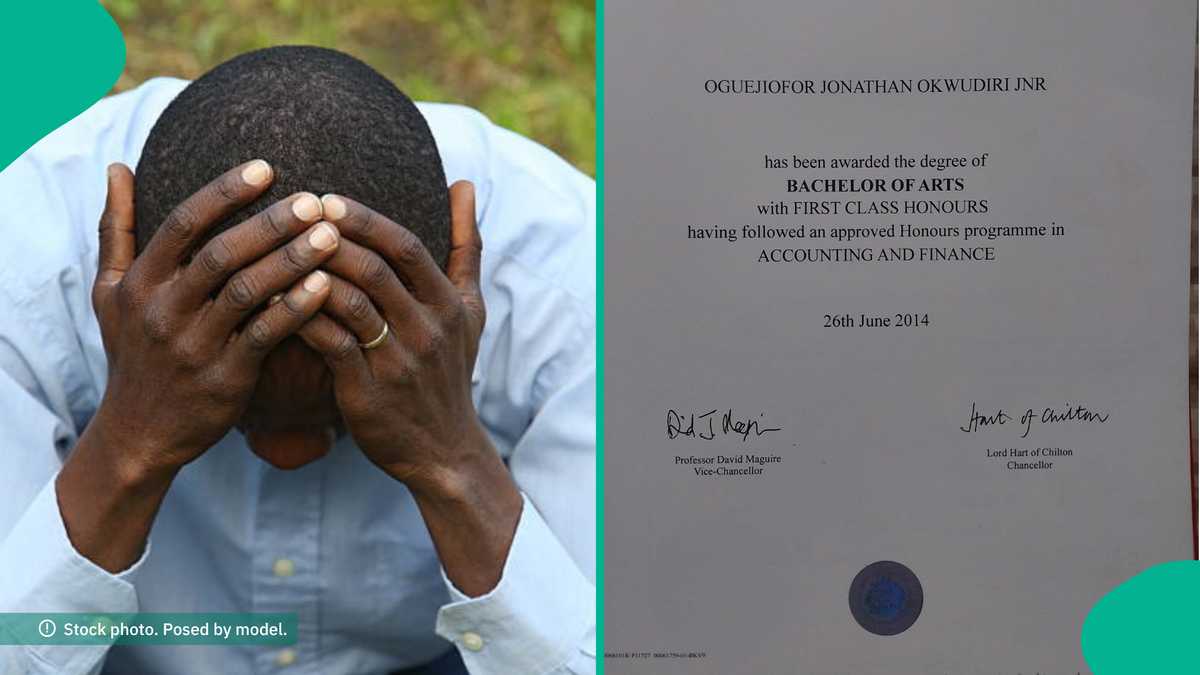
A first class degree from a British university. Eleven years without a job. That is the reality Oguejiofor Jonathan Okwudiri Jnr laid bare in a single post on X, and Nigeria took notice.
The Nigerian graduate, posting under the handle @JayDCryptonite, shared a photograph of his degree certificate from the University of Greenwich alongside a message stripped of self-pity but heavy with meaning: “First class Graduate. BA Hons Accounting & Finance. Since 2014. No Job. Nigeria is humbling.” Seven words at the end. Seven words that said everything.
His certificate is not in question. Awarded on 26 June 2014, signed by then Vice-Chancellor Professor David Maguire and Chancellor Lord Hart of Chilton, it confirms he completed an approved Honours programme in Accounting and Finance at the London-based institution. A first class from a recognised British university is, by any reasonable measure, a serious academic achievement. In most countries, it opens doors quickly. In Nigeria, it apparently opened none.
Okwudiri did not elaborate on every closed door or failed application. He did not need to. The bare facts — a decade-plus of unemployment despite holding an internationally recognised qualification — spoke loudly enough to resonate with thousands of Nigerians who have lived some version of the same story. The post spread rapidly, drawing reactions that ranged from sympathy to blunt challenge.
Among those who responded, a user named Home boy put the sharpest question on the table: “Uk university? Wetin you find come back 9ja? You no see fully funded PhD for that way ni.” It is an uncomfortable but legitimate point. Many Nigerians who graduate from British institutions choose to remain in the United Kingdom or pursue further study abroad, precisely because they anticipate the wall that Okwudiri appears to have hit. The fact that he returned home and still cannot find work raises harder questions about what Nigeria actually offers its most academically accomplished citizens.
The broader context makes the individual story worse, not better. Nigeria’s graduate unemployment crisis is not new, and it is not getting smaller. The labour market is shaped by sluggish private sector growth, a narrow base of formal employment, and an economy that has consistently failed to generate enough quality jobs to absorb its educated workforce. Weak infrastructure, policy inconsistency and a business environment that discourages investment all feed into the same outcome: qualified people, sitting idle.
None of this diminishes what Okwudiri achieved academically. But it does force a reckoning with what Nigeria is doing — or failing to do — with the talent it produces. A country that cannot find a use for its first class graduates is not merely wasting individuals. It is wasting itself. The emotional weight of one post on X should not be necessary to make that point, but here we are.