
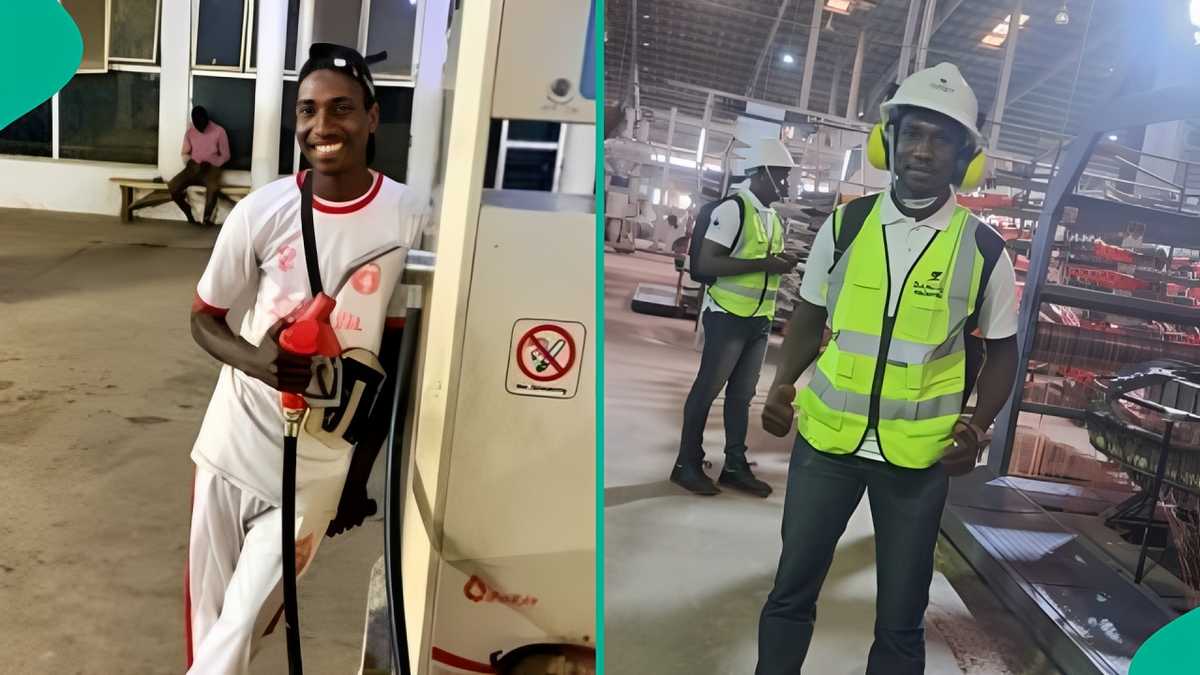
Abdulkadir Garba Yusuf had a Political Science degree from Bayero University Kano and, like thousands of Nigerian graduates before him, no immediate path forward. Rather than wait indefinitely for a role that matched his qualifications on paper, he walked into ABcon Oil & Gas Ltd Filling Station in Rijiyar Lemo, Kano, handed over his CV, and accepted a position as a pump attendant at ₦45,000 a month. That decision, which drew ridicule from people who considered it beneath a university graduate, has since led him to the Dangote Petroleum Refinery and Petrochemicals Graduate Trainee Programme — one of the most coveted entry points into Nigeria’s industrial economy.
Yusuf shared his story on LinkedIn in September 2026, and the post spread rapidly across professional networks. It is not difficult to understand why. His account cuts through the polished career narratives that dominate social media and presents something more honest: a young man standing on his feet for eight hours a shift, absorbing mockery, and choosing to treat a low-wage job as a foundation rather than a humiliation. “I would rather work, learn and grow than remain idle simply because the job title was not what I expected,” he wrote. That is not motivational language for its own sake — it is a straightforward description of a practical choice.
A Career Built One Step at a Time
After six months at the filling station, Yusuf moved on. He joined Chicken Flavours Kano as a cashier and was promoted to supervisor within two months — a detail worth noting, because it suggests the filling station stint was not merely endured but used. He was developing the kind of reliability and work ethic that employers notice. His national youth service then took him to Borno State, where his performance was exceptional enough to earn him the position of Platoon Leader 3 and, subsequently, Corps Camp Director for NYSC Batch A Stream 1 in 2025. The Borno State NYSC command issued him a formal commendation letter. He was also posted to the 7 Division Nigerian Army Headquarters, Sector 1, Operation Hadin Kai, working in a finance and accounts environment that, by his own account, shaped his professional thinking in ways that a conventional office posting might not have.
The service year was not without personal cost. Yusuf lost his mother during that period, a grief he carried while continuing to meet his obligations. He completed NYSC and was back in the workforce within 48 hours of receiving his discharge certificate, recalled by his former employer to manage a newly opened branch in Kaduna State before eventually returning to Kano. It was from that position — still building, still proving himself — that he applied for the Dangote Graduate Trainee Programme and was accepted into its first cohort.
What This Story Actually Says About Nigeria
The response to Yusuf’s post was warm and widespread, with commenters drawing the obvious lessons about humility and perseverance. Those lessons are real. But there is a harder, less comfortable point sitting underneath this story that deserves to be stated plainly. A Political Science graduate from one of Nigeria’s established universities should not need to spend years navigating survival jobs before accessing the kind of structured professional development that the Dangote programme represents. The fact that Yusuf’s journey reads as inspirational is partly a reflection of how badly the Nigerian graduate employment market has failed, and how rarely young people with genuine ability and discipline find a direct route into meaningful work.
None of that diminishes what Yusuf achieved. His choices were sound at every stage, and his willingness to work without vanity is precisely the quality that serious employers — including, evidently, the Dangote group — are looking for. His own summary of the journey, written in the understated register of someone who has genuinely earned the right to say it, captures the arc cleanly: “From ₦45,000 as a pump attendant to becoming a Dangote Graduate Trainee. Alhamdulillah for the journey.” The journey was real. So was the work that made it possible.