
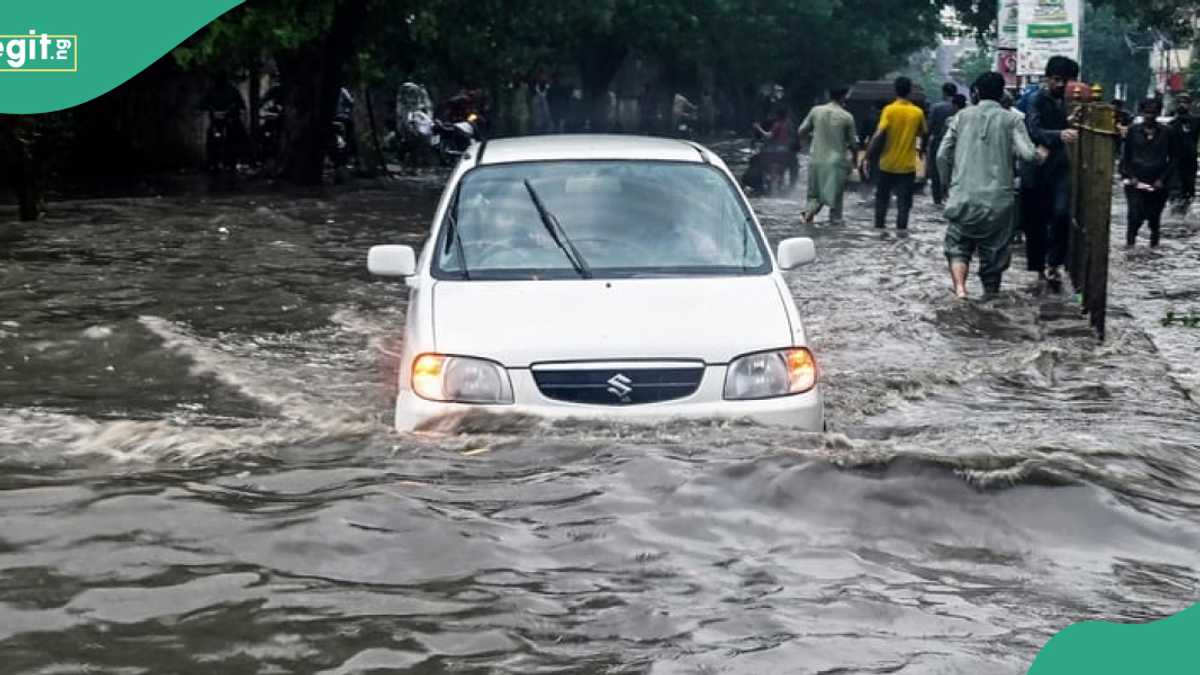
The bridge was gone — not destroyed, but buried under a surge of brown water that had swallowed the Ebeano-Gudu road whole.
On Saturday, residents on both sides of that crossing stood stranded, unable to move in either direction as floodwaters from a single afternoon’s rainfall turned one of Abuja’s busiest connecting routes into an impassable river. One resident, phone in hand, recorded the scene and addressed the footage directly to the Minister of the FCT: “Dear Honourable Minister of the FCT, please come to our rescue. This is the current situation of Ebeano/Gudu Road. The bridge is flooded. People coming from Gudu junction can’t cross; people coming from Ebeano can’t get to Gudu. Mr Project, please come and help us.” The appeal was raw, unscripted and entirely reasonable.
The flooding was not confined to one neighbourhood. Adetokunbo Ademola Crescent in Wuse 2 went under. The area around Delight Event Centre in Gudu was overwhelmed. Efab Estate in Lokogoma reported the same. The bridge connecting Gaduwa and Durumi was cut off for several hours, severing movement between two communities. Across affected districts, businesses shuttered as the water rose, and a number of vehicles — some of them expensive — were either submerged or damaged beyond immediate use.
Emma Ik Umeh, speaking on social media in response to the Wuse 2 flooding, confirmed that cars had been swamped by the deluge. His account was one of several circulating online as Abuja residents documented what had become, in the space of a few hours, a city in visible distress.
What makes Saturday’s scenes particularly difficult to excuse is the volume of advance warning that preceded them. The Nigeria Meteorological Agency had already flagged elevated flood risk across the country ahead of this rainy season. The Nigeria Hydrological Services Agency went further, issuing National Flood Advisory NFA-2026-200, which warned of medium flood risk across 17 states between 21 and 27 July 2026, and noted that 16 gauging stations nationwide had already breached watch and warning thresholds. NIHSA’s Director General explicitly urged state governments and residents on floodplains to begin immediate evacuation. The FCT was named among the high-risk zones in the Annual Flood Outlook, with Abuja specifically identified as vulnerable to flash flooding. The federal government had separately acknowledged that climate change is driving more intense and frequent downpours that can overwhelm existing drainage systems.
The warnings, in other words, could not have been clearer. Yet Saturday came and went like a demonstration of precisely what the agencies had cautioned against — streets turned to canals, residents marooned, cars ruined, and a city caught flat-footed.
The broader picture is sobering. Nigeria’s Annual Flood Outlook for 2026 places over 14,000 communities at high risk, with severe projected impacts on agriculture, infrastructure and livelihoods. Coastal, riverine and flash flooding are anticipated across multiple states, and NIHSA has warned that conditions could deteriorate further between August and September — the peak of the rainy season. Abuja sits squarely in that window.
The question residents are now asking is not a new one, but it has become impossible to avoid: does Abuja’s drainage infrastructure actually match the demands of a capital city in a changing climate? The evidence on Saturday suggested it does not. Streets built to handle ordinary rainfall cannot cope with the intensity that is now arriving with increasing regularity, and no amount of ministerial branding or urban development rhetoric changes that physical reality.
Behind the submerged cars and the blocked bridges, there are people — commuters who could not get home, traders who lost a day’s income, families in estates watching water creep towards their front doors. Their appeal to the minister was not theatrical. It was the sound of a city asking, plainly and urgently, whether anyone in authority is actually paying attention before the worst of the rains arrive.