
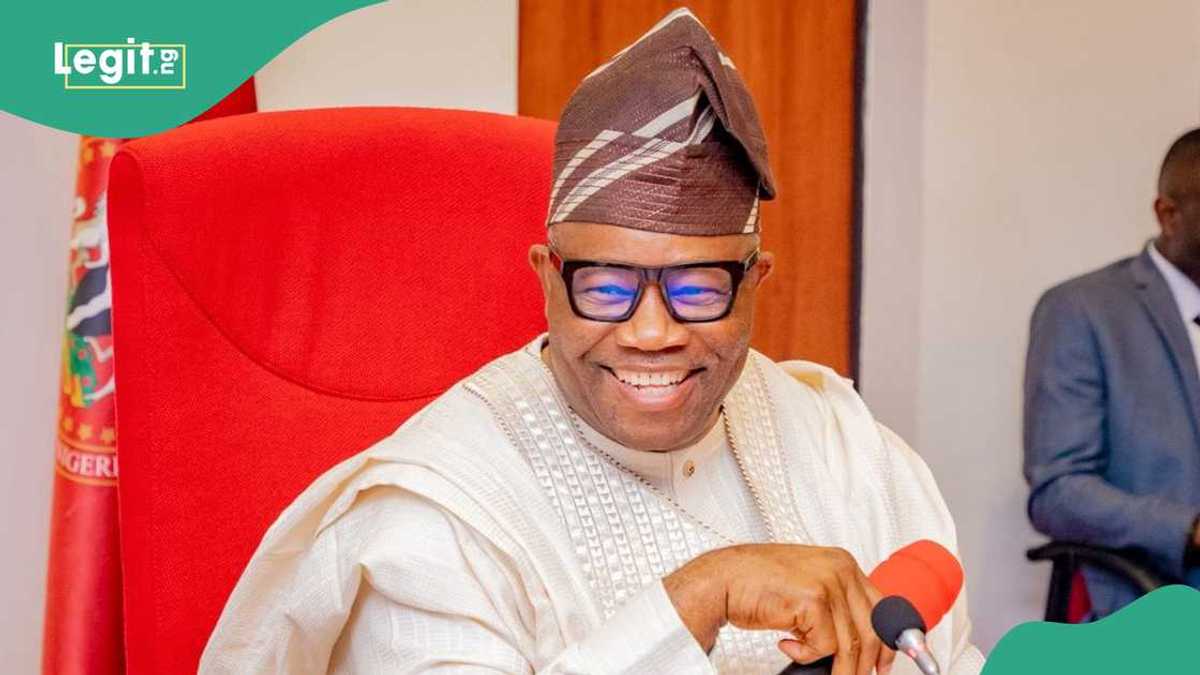
What happened?
On Tuesday, 1 September, the Akwa Ibom State Government published a Facebook post describing Senate President Godswill Akpabio as the “Acting President of Nigeria”. The post appeared during the state government’s official livestream of a reception ceremony for a new Ibom Air aircraft at Victor Attah International Airport in Uyo. It read, in full:
“Arrival of the Acting President of Nigeria, Sen. Dr. Godswill Akpabio, GCON, President of the Senate, Chairman of the National Assembly, at the Official Reception and Water Cannon Ceremony for the brand-new Airbus A220-300, as part of the activities commemorating the 39th Anniversary Celebration of Akwa Ibom State.”
The post was quietly edited afterwards — but not before screenshots circulated widely. The aircraft in question, registered as 5N-CDC, is one of ten planes ordered under former Governor Udom Emmanuel’s administration and formally handed over at Airbus’s final assembly facility in Mirabel, Canada, before flying into Uyo.
Why does the title matter constitutionally?
This is not merely a social media slip. The title “Acting President” carries specific constitutional weight in Nigeria, and applying it incorrectly points to either a serious misunderstanding of the law or something more deliberate.
President Bola Tinubu had departed Abuja for Europe on 30 August for his annual leave, with London as his first stop. Vice President Kashim Shettima had also been abroad — he left for Luanda on 29 August to represent the president at the 21st Extraordinary Session of the African Union Assembly of Heads of State and Government, returning to Abuja on Monday, 31 August.
What does the Constitution actually say?
Section 145 of Nigeria’s 1999 Constitution is unambiguous: when a president goes on leave, he must transmit a written declaration to the Senate President and the Speaker of the House of Representatives. Once that letter is sent, the Vice President — not the Senate President — steps in to perform presidential functions. The Presidency had not publicly confirmed that any such letter was transmitted before Tinubu’s departure.
Section 146 goes further. It restricts the Senate President’s assumption of presidential powers to a specific scenario: when both the offices of president and vice president become vacant simultaneously. A president and vice president being temporarily outside the country does not meet that threshold.
In plain terms, even if Tinubu and Shettima had both been abroad at the same time, Akpabio would still not have been “Acting President” under any proper constitutional reading.
How did Akwa Ibom’s government respond?
When journalists contacted Akwa Ibom’s Commissioner for Information, Aniekan Umanah, on Tuesday night, his first response was a flat denial — he claimed no such post had ever appeared on the state government’s page. When presented with a screenshot, he changed tack.
“I don’t know. Maybe somebody made a mistake. There’s nothing like that (acting president) in the country,” Mr Umanah said.
Pressed further, he added: “Nobody authorised that (reference) here. Maybe the people typing may have made a mistake, but that cannot be the position of the state government.”
The sequence — denial, then grudging concession — is worth noting. A straightforward clerical error would typically prompt an immediate, uncomplicated apology. The initial denial suggests the commissioner either had not been briefed or was buying time.
Who is Akpabio, and why was he at the event?
Godswill Akpabio is not a stranger to Akwa Ibom affairs. He governed the state from 2007 to 2015, then served as senator for Akwa Ibom North-West District before ascending to the Senate presidency. His presence at the anniversary event was entirely expected — he remains a dominant political figure in the state.
President Tinubu is separately scheduled to visit Akwa Ibom to commission projects as part of the same 39th anniversary programme, which makes the “Acting President” label all the more conspicuous. Akpabio was a guest; the actual president was due to follow.
Is there a separate disinformation angle to this story?
Yes — and it is worth separating clearly from the main facts. A viral video circulating on Facebook falsely portrayed Akpabio announcing his resignation from the All Progressives Congress ahead of the 2027 elections. The 18-second clip featured audio of Akpabio saying: “I write to formally tender my resignation letter from the APC effective today. This decision has not been taken lightly…”
The footage is fabricated. No credible source has corroborated the claim, and it bears the hallmarks of the manipulated audio clips that have become a recurring feature of Nigeria’s pre-election information landscape. Readers should treat it as disinformation.
What does this episode actually tell us?
Taken at face value, the Akwa Ibom post was a clumsy error by a social media handler who either did not understand constitutional procedure or was carried away by the politics of the moment. That is the most charitable reading.
The less charitable reading is that the label reflected a political sentiment — that with Tinubu abroad, Akpabio, as a son of Akwa Ibom soil and the country’s most senior legislative officer, deserved a grander introduction. Either way, the episode exposes a gap in how Nigerian state governments manage official communications, and it raises a legitimate question about whether the Presidency followed due constitutional process before Tinubu left for Europe.
A single Facebook post might seem trivial. But in a country where constitutional procedure around executive succession has historically been contested — and sometimes weaponised — getting these details right is not a matter of pedantry. It is a matter of governance.