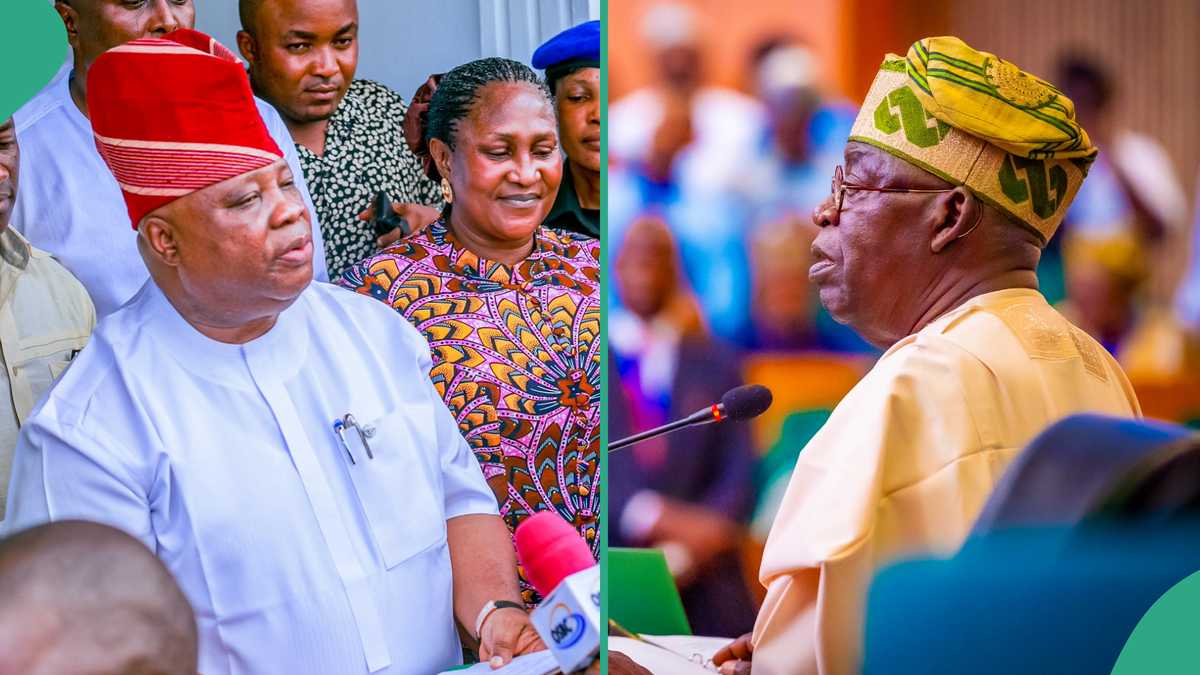
The tension building around Osun State’s August 2026 governorship election took a sharp turn this week when Governor Ademola Adeleke stepped before the cameras and addressed President Bola Tinubu directly — not through a press release, not through intermediaries, but in plain, pointed language that left little room for misinterpretation. It was the kind of public statement that signals a political relationship under serious strain, and it has set tongues wagging across the country.
To understand how things reached this point, it helps to go back to the uneasy political arrangement that preceded it. The Accord Party, which holds some sway in Osun, had endorsed Tinubu as its presidential candidate — a gesture of political goodwill that Adeleke’s Peoples Democratic Party camp clearly expected would translate into some degree of federal restraint ahead of the state’s election. That expectation, it seems, has not been met. Adeleke made his frustration explicit, asking on camera: “President Tinubu, the Accord Party has endorsed you as its presidential candidate. Why are we suffering again?” It was a blunt question, and it framed everything that followed.
Identifying himself as the Chief Security Officer of Osun State — a designation governors invoke when they want to assert constitutional authority over security matters on their turf — Adeleke then issued his warning. He reached back into Nigeria’s bruising political history to make his point, invoking the 1983 election crisis in Ondo State, when Chief Michael Ajasin was widely alleged to have been rigged out of power in circumstances that descended into disorder and bloodshed. The reference was deliberate and unmistakable. “If anybody tries to do otherwise,” Adeleke said, “the political crisis of 1983, when some people tried to rig Michael Ajasin out of power in Ondo State, may repeat itself again.” He was not predicting violence so much as warning that electoral interference carries consequences — but the invocation of 1983 is not a gentle one.
The statement spread quickly on social media, and Nigerians responded with the full spectrum of opinion one would expect. Some found the governor’s posture hypocritical. Taofik Sulaimon put it sharply: “When it’s time for politics, governors are the CSOs; when it’s time for insecurity, the president is the CSO of every state.” The observation cuts at a genuine inconsistency — state executives tend to claim security authority when it suits them and shed it when it does not. Others were less measured. A commenter named Aderemi dismissed the governor’s warning altogether, arguing that Adeleke himself came to power through questionable means and would face the same fate in 2026. Kayode Wusu went further, calling on Tinubu to respond with a show of federal force, while Adeshina Sule offered a more philosophical verdict in Yoruba, suggesting that those plotting ill-deeds always find a way of exposing themselves.
The backdrop to all of this grew more combustible days earlier, when police raided the Osogbo home of Osun’s Secretary to the State Government, Teslim Igbalaye. Officers arrested Igbalaye and five other individuals, recovering over ₦4.8 million in cash, two Permanent Voter Cards, a voter register, and electronic equipment from the premises. The haul raised obvious questions about what was being planned and by whom. The Osun State Government hit back immediately, accusing the police of conducting the raid without a search warrant — a procedural objection that, if true, matters legally, but does not answer the question of what all that cash and those voter cards were doing in the SSG’s house in the first place.
What is clear, as the August 15 date approaches, is that Osun is shaping up to be one of the most contested and potentially volatile governorship elections in the current political cycle. Adeleke is fighting for his political life. The federal government has an obvious interest in the outcome. And the institutions meant to guarantee a free vote — the police, the electoral commission, the courts — are already being pulled into the dispute before a single ballot has been cast. Nigeria has been here before. The question is whether it will handle it any differently this time.