
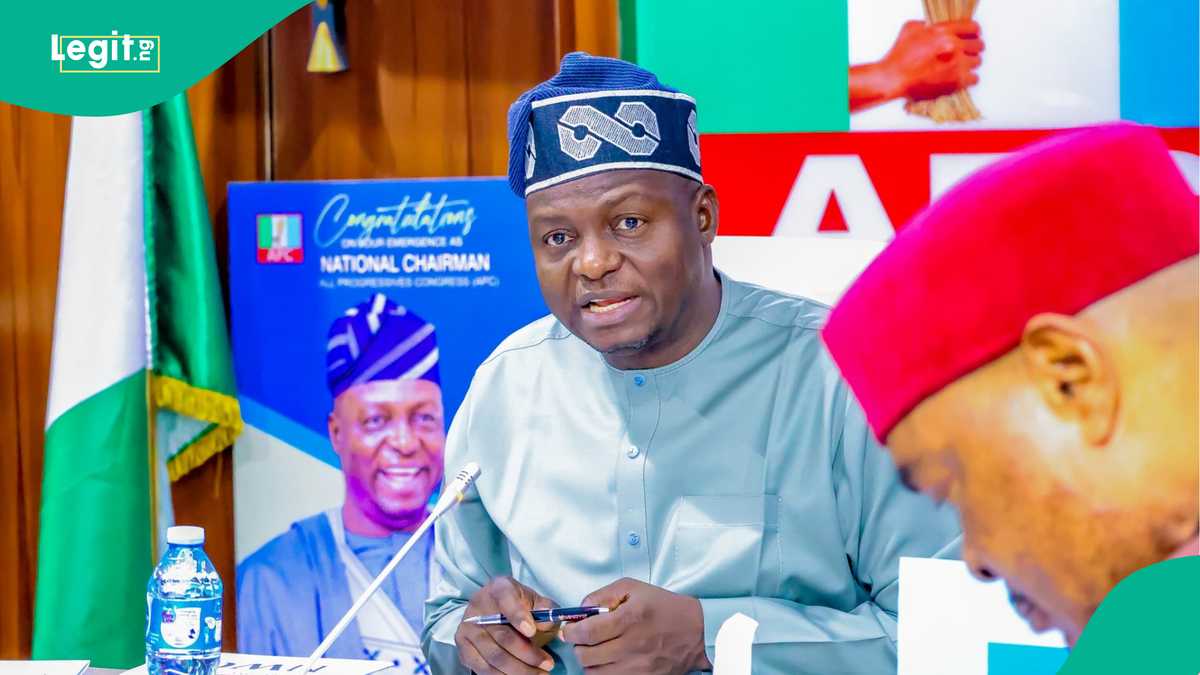
There is a particular kind of political theatre that unfolds not on podiums or in press conferences, but in private sitting rooms, over shared tea and carefully chosen words. That is precisely the arena in which All Progressives Congress National Chairman, Professor Nentawe Yilwatda, has been operating with increasing frequency — and the latest stop on his tour was the Kano home of Senator Kabiru Gaya, a man who helped build the APC and then walked away from it.
Gaya is not a minor figure. He was among the original architects of the APC, one of those who laboured to stitch together the coalition that eventually swept President Goodluck Jonathan from power in 2015. His subsequent departure to the New Nigeria Democratic Congress was felt as a genuine blow in Kano state politics, where his name still carries weight. That Yilwatda chose to sit with him personally, rather than send an emissary, tells you something about how seriously the ruling party is taking the business of political consolidation ahead of 2027.
Yilwatda confirmed the meeting himself, framing it in the language of statesmanship rather than recruitment. “We agreed that leaders have a responsibility to promote dialogue and peaceful coexistence,” he said, offering nothing more concrete than warm words about Kano’s political stability. No defection was announced. No formal alignment was declared. But the visit happened, and in Nigerian politics, visits of this kind are rarely without purpose.
What makes this encounter particularly significant is that it did not occur in isolation. Yilwatda has been quietly building a pattern of targeted outreach across northern Nigeria that, taken together, looks less like courtesy and more like a carefully coordinated pre-election strategy. In April 2026, he travelled to Kano alongside Senator Bello Hayatu Gwarzo to call on former Governor Ibrahim Shekarau at his Mundubawa residence. Shekarau is a PDP figure of considerable standing, and the message from that visit was unambiguous — the APC wanted his support, and it wanted northern solidarity to be the vehicle that delivered it.
The pattern continued on 13 July 2026, when Yilwatda arrived in Gombe to visit Senator Usman Bayero Nafada, another seasoned PDP stalwart. He was accompanied by Gombe State Governor Inuwa Yahaya and a delegation of party officials, lending the occasion an air of institutional weight rather than personal diplomacy. The themes at that meeting were familiar — unity, peace, cross-party cooperation for the sake of development — the same vocabulary that has characterised all of these encounters, as though the APC has settled on a single script and is delivering it at each door it knocks on.
Taken individually, each of these visits might be dismissed as routine political socialising. Taken together, they reveal a deliberate and methodical effort by the ruling party to draw experienced opposition figures into its orbit before the 2027 general elections formally gather pace. The logic is straightforward enough: in a political environment where personal loyalty and regional networks remain decisive, neutralising credible opposition voices — or better still, converting them — can shift the balance of a contest before a single ballot is cast.
The broader objective is not difficult to read. President Bola Tinubu will seek re-election in 2027, and the north remains the electoral terrain where that bid will be made or broken. By deploying his national chairman on this quiet offensive, the APC is doing what ruling parties have always done in Nigeria — using the levers of access, prestige and the promise of relevance to bring wavering figures back inside the tent. Whether Gaya, Shekarau, Nafada or others will ultimately respond to the overture remains to be seen. What is already clear is that the APC is not leaving that question to chance.