
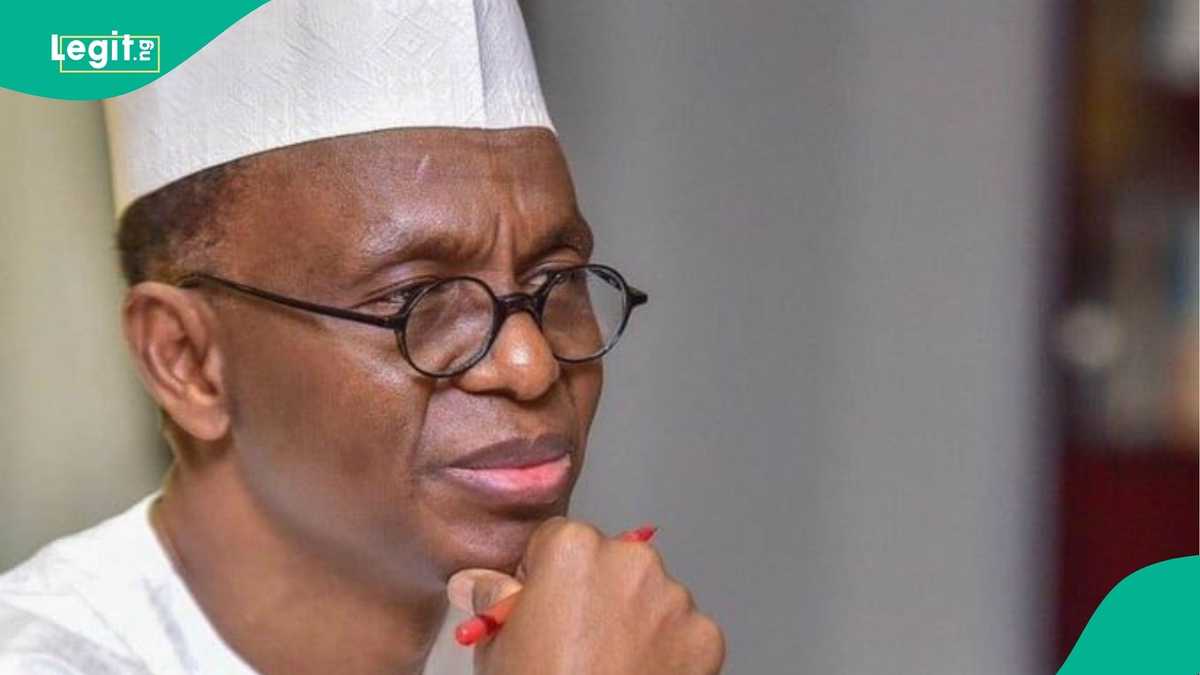
A forensic investigator has told a Kaduna court that former Governor Nasir El-Rufai and associates allegedly earmarked $600,000 to pay off Economic and Financial Crimes Commission officials and intermediaries. The claim, made under oath, is as serious as Nigerian corruption allegations get.
What the witness told the court
Segun Kayode, a Department of State Services forensic investigator and the first prosecution witness in the case, gave his testimony before Justice Darius Khobo at the Kaduna State High Court in Kawo on Tuesday. He told the court the alleged sum was split into two tranches — $500,000 and $100,000 — and that forensic audio recordings captured conversations involving El-Rufai and several suspected associates discussing how to obstruct an EFCC investigation into a company called Singularity.
Among those allegedly named in the recordings were a Senior Advocate of Nigeria, one other unnamed individual, and Bashir El-Rufai. Kayode said the Senior Advocate and his unnamed associate were allegedly directed to contact a man named Ahmadu Sule to obtain a template previously used to wind down another company, with the intention of applying the same process to Singularity.
The recordings allegedly went further. Kayode told the court the discussions covered plans to liquidate Singularity both in Nigeria and in Mauritius, where the Nigerian Financial Intelligence Unit was reportedly also investigating it. There were also alleged conversations about blocking the EFCC from probing a company listed on the New York Stock Exchange. The proceedings lasted nearly eight hours — from 12:26 pm to 8:18 pm — with approximately two hours spent playing the audio recordings in court.
Defence raises procedural objections
El-Rufai’s lead counsel, Paul Erokoro (SAN), challenged the testimony from the outset. He argued that Kayode’s name and a summary of his evidence were absent from the prosecution’s proof of evidence, which he said violated the defence’s right to a fair hearing under Section 210 of the Administration of Criminal Justice Law, 2017. He further contended that the defence should have been served with the subpoena.
Ayodeji Adedipe (SAN), counsel for the Independent Corrupt Practices and Other Related Offences Commission, pushed back. He noted that Kayode had been subpoenaed by the court on 30 June 2026 and argued that the omission did not automatically disqualify him from testifying, since the defence would still have the opportunity to cross-examine him.
Justice Khobo ruled that the court records confirmed the subpoena, even if Kayode’s details were missing from the proof of evidence. He allowed the testimony to proceed on the condition that the defence could cross-examine the witness. When Kayode submitted a hard copy of his findings, the defence complained again that it had not been given adequate time to study the document. The court directed the defence to obtain a certified true copy, which was admitted as Exhibit One. The case was adjourned to 30 November and 1 December 2026 for cross-examination to continue.
El-Rufai’s broader legal troubles
El-Rufai arrived at court at around 11:50 am alongside Isah Ashiru, the African Democratic Congress governorship candidate in Kaduna State. He has been held in ICPC custody since 18 February 2026 over alleged financial misconduct during his tenure as governor between 2015 and 2023. Days before Tuesday’s hearing, the Court of Appeal in Kaduna dismissed his bail appeal on 9 October, ruling that he had not established sufficient grounds for the appellate court to intervene.
His legal difficulties do not end there. A Federal High Court in Abuja previously dismissed a lawsuit El-Rufai filed against the ICPC and three other agencies over alleged threats to his bank accounts and properties. The court found that he had filed similar suits before two different courts within 12 days — a move it characterised as an abuse of court process. El-Rufai had sought N1 billion in damages and a perpetual injunction to protect assets he claimed were purchased with lawful severance pay as governor.
Key facts at a glance
The allegations against El-Rufai are numerous and interconnected. Here are the central facts the court has heard so far.
- A DSS forensic investigator testified that $600,000 was allegedly split into two sums — $500,000 and $100,000 — to pay EFCC officials and intermediaries tasked with frustrating an investigation into Singularity.
- Audio recordings played in court allegedly captured El-Rufai and associates discussing plans to liquidate Singularity in Nigeria and Mauritius, and to shield a New York Stock Exchange-listed company from EFCC scrutiny.
- El-Rufai has been in ICPC custody since February 2026, his bail appeal was dismissed in October 2026, and a separate Federal High Court suit he filed was thrown out as an abuse of process.
Cross-examination of the DSS witness will resume at the end of November. What emerges then will determine how much of the prosecution’s case holds up under scrutiny — and whether El-Rufai’s legal team can mount a credible challenge to what, on the face of it, is damaging testimony.