
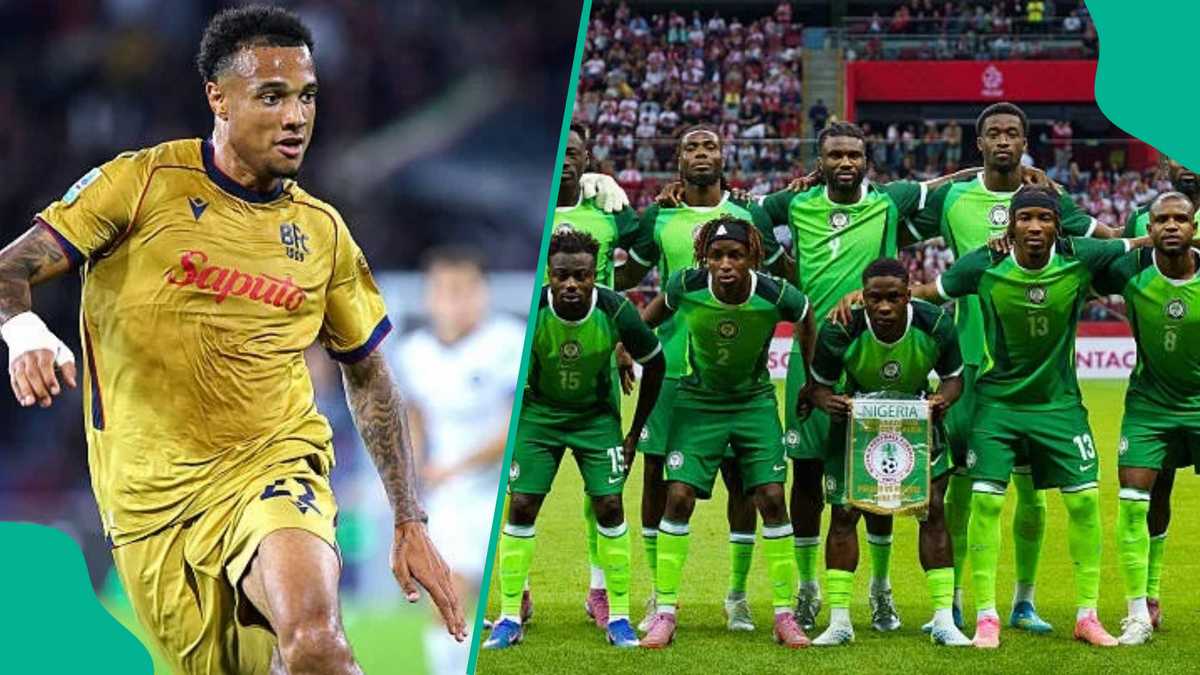
The story begins in the Netherlands, where Jay Enem was born 23 years ago to parents of Nigerian descent, growing up far from Lagos or Abuja but never entirely severed from the country his family calls home. For much of his young career, the question of international allegiance remained open, with no national team — senior or youth — ever calling upon him at any level. That uncapped status, which might once have seemed like an oversight, has now become his most valuable asset in the eyes of the Nigerian Football Federation.
Enem spent time developing his craft before earning a move to Serbian giants Red Star, the kind of club that sharpens a player’s edge under genuine competitive pressure. It was there that he caught the attention of Bologna, one of Serie A’s more progressive clubs, who brought him to Italy during last summer’s transfer window. He wasted little time making himself known, finding the net against Lecce within his opening weeks in the Italian top flight — a confident start that confirmed the scouting reports which had followed him across Europe.
By the time his performances in Italy began attracting wider attention, his representatives had already made a move of their own. They reached out directly to Super Eagles head coach Eric Chelle, signalling Enem’s willingness to commit his international future to Nigeria rather than wait on a Dutch call-up that may never materialise. Chelle, who has been methodical in his approach to squad-building since taking charge, responded not with an immediate call-up but with something arguably more considered: he placed the striker under formal observation, watching his progress before making any binding decision.
The timing of this development is not incidental. It follows closely on the heels of George Ilenikhena‘s decision to align with Nigeria, a move that generated considerable attention given that the 20-year-old had turned down a France Under-21 invitation to do so. Ilenikhena, born in Nigeria and raised in France, marked his Super Eagles debut by scoring against Madagascar in the Africa Cup of Nations qualifiers — precisely the kind of statement arrival that makes other diaspora players take notice. He has since added five goals and three assists across seven appearances for Al-Ittihad in Saudi Arabia, demonstrating that his commitment to Nigeria was not a sentimental gesture but a calculated one.
Should Enem receive and accept a formal call-up, he would enter a dressing room that already carries significant diaspora representation, joining a lineage that includes Alex Iwobi, Ademola Lookman, Calvin Bassey, William Troost-Ekong, Ola Aina, Fisayo Dele-Bashiru and several others who were born or raised in Europe yet chose to wear the green and white. This is not a new phenomenon for Nigeria — it is a structural feature of the national team’s talent strategy, one that has delivered some of the most technically accomplished players in the squad’s recent history.
What distinguishes the current moment is the apparent momentum behind it. Two diaspora forwards, both with credible European pedigrees, moving toward the Super Eagles within the same qualifying cycle suggests that Chelle’s project is beginning to carry genuine appeal beyond Nigeria’s borders. Whether Enem earns his call-up in the next window or the one after will depend on how consistently he performs in Serie A, but the groundwork has been laid. The conversation has started, and Nigeria, for once, appears to be on the front foot.