
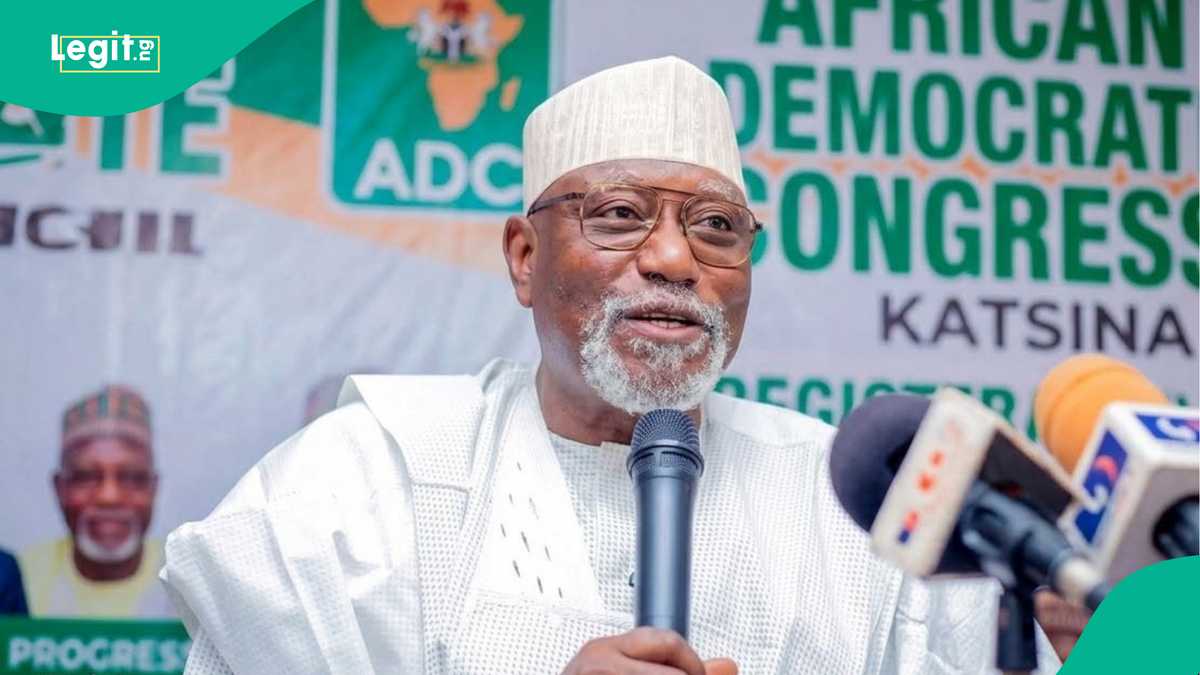
Lawal Musa Daura, the former Director-General of the Department of State Services, has made his move. The ex-spy chief has formally left the African Democratic Congress and pitched his tent with the Allied People’s Movement, citing what he describes as entrenched injustice and a collapse of credible leadership within the ADC. For a man who once ran Nigeria’s foremost domestic intelligence agency, the decision was characteristically measured — and, by his own account, not as sudden as it appeared.
Daura had previously sought the ADC’s governorship ticket in Katsina State, a fact that prompted immediate speculation about sour grapes. He addressed that head-on, dismissing the suggestion that a denied ticket had sent him packing. He told Daily Trust that he had actually departed the party several months before the noise began, choosing silence deliberately while he weighed his next steps. That is either the behaviour of a man with genuine political discipline, or a very well-managed exit — possibly both.
His stated reasons for leaving carry some weight. The ADC has not been a picture of stability. Daura pointed to persistent internal crises and a failure of leadership as conditions that made remaining untenable. These are not unusual complaints in Nigerian opposition politics, where parties frequently splinter along personal loyalties rather than ideological lines, but coming from a former intelligence chief, the language is notably restrained. He did not name names. He did not threaten. He simply left.
What is harder to dismiss is the broader argument Daura made about why he entered politics at all. “I joined politics not to achieve personal ambition,” he said, “but because of my concern for the country and its people. I want to change people’s belief that lies, dishonesty and deception are part of politics.” That is a bold claim for any politician to make, let alone one stepping from one party to another ahead of an election cycle. Whether the APM provides a more honest environment than the ADC remains, to put it mildly, unproven.
He identified insecurity, poor governance and economic hardship as the issues that drew him into the political arena, and insisted those concerns travel with him regardless of which party badge he wears. Given his background running the DSS under the first Buhari administration, his credibility on security matters is not in question. His record in that role, however, attracted its own controversies — a fact that any honest assessment of his political prospects must acknowledge.
The APM’s Katsina State Chairman, Nura Abdullahi, welcomed Daura and other defectors warmly, promising fair treatment and suggesting their arrival would reinforce the party’s structures in the state. That is standard reception language, but the practical question is whether the APM can translate new faces into real votes in 2027. Daura himself described the party as currently free of the internal divisions that wrecked the ADC, calling it a winning platform. That verdict may prove optimistic.
When pressed on which specific office he intends to contest, Daura declined to commit. He said, pointedly, that holding office was not the condition for his continued involvement in public life — that his commitment to Nigeria’s development would not waver whether or not he secured a political role. It is a sensible position to hold publicly at this stage, and it keeps his options open. But Katsina’s governorship race is clearly the prize he has had in view, and few observers are likely to be fooled by studied ambiguity.
What Daura’s defection ultimately signals is less about the APM’s prospects and more about the fragile state of Nigeria’s opposition landscape. Parties rise and fall on the strength of individual personalities rather than institutional coherence. A former DSS director-general lending his name to a relatively unknown platform does not transform that platform overnight. It does, however, add a recognisable figure to the 2027 conversation in Katsina — and in Nigerian politics, name recognition is rarely nothing. Whether Daura can convert it into something more durable is the question that 2027 will answer.