
What happened in Abuja, and why does it matter?
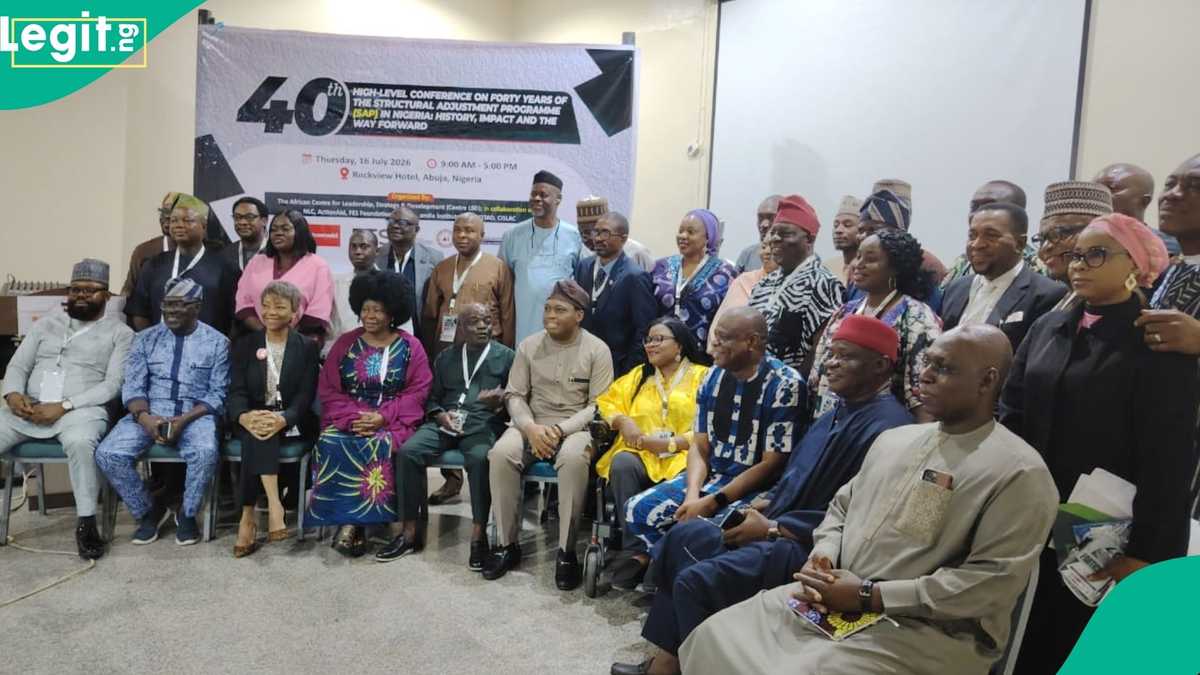
On Thursday, 16 July, a significant gathering of labour leaders, economists, civil society organisations and development experts convened in Abuja to deliver a blunt assessment of four decades of market-driven economic reform in Nigeria. The conference, titled “Forty Years of Structural Adjustment Programme (SAP) in Nigeria: History, Impact and the Way Forward,” was organised by the African Centre for Leadership, Strategy and Development alongside ActionAid Nigeria, the Nigeria Labour Congress, the Centre for Democracy and Development, Friedrich Ebert Foundation and several other partner organisations. The verdict was unambiguous: the model has not worked.
The timing is deliberate. Nigeria adopted the Structural Adjustment Programme in 1986 under pressure from the International Monetary Fund and the World Bank, promising that liberalising markets, cutting subsidies and shrinking the state would unlock growth and prosperity. Forty years on, the country remains heavily import-dependent, industrialisation has stalled, and poverty has deepened. The experts gathered in Abuja are not merely revisiting history — they are making an argument about what is happening right now.
What exactly was SAP, and what did it do to Nigeria?
SAP was a package of economic conditions attached to international loans, built around what became known as the Washington Consensus: devalue the currency, remove subsidies, privatise state enterprises, liberalise trade and reduce government spending. The logic was that market forces, once unleashed, would allocate resources more efficiently than the state ever could. Nigeria’s government accepted these terms in 1986 and restructured much of its economic policy accordingly.
The consequences, as the conference made plain, were far-reaching. Founding executive director of the Centre, Dr Otive Igbuzor, opened proceedings by noting that SAP “fundamentally altered the direction of Nigeria’s economy and society,” and that its effects are still being felt today. Public services were commercialised, social spending was cut, and the naira was devalued — moves that transferred enormous economic pain onto ordinary Nigerians while the promised industrial transformation never materialised.
Delivering the keynote on behalf of political economist Professor Adebayo Olukoshi, Egghead Odewale of AIPCTA described SAP as perhaps the most consequential economic reform in Nigeria’s post-independence history, arguing that current debates on privatisation, debt sustainability and subsidy removal cannot be understood without grasping what SAP set in motion.
So why are we talking about SAP now, in 2025?
Because, according to the experts in Abuja, the same prescriptions are being applied today. Dr Igbuzor drew a direct line between the 1986 programme and the reforms currently being pursued by President Bola Tinubu’s administration — specifically, the flotation of the naira and the removal of the fuel subsidy. These are not new ideas dressed in new language; they are, structurally, the core pillars of SAP revisited.
Pro-democracy activist Ayo Obe was equally direct. “The floating of the naira and fuel subsidy removal are core principles of SAP,” he said. “President Tinubu’s reforms are another attempt to see whether Nigeria can implement SAP and get it right.” The implication is uncomfortable: Nigeria has been here before, the results were damaging, and the country appears to be repeating the experiment without sufficiently interrogating why it failed the first time.
ActionAid Nigeria’s Head of Programmes and Policy, Celestine Odo, brought the human cost into sharp focus. His organisation’s assessments following the 2023 subsidy removal found that many households can no longer consistently afford three meals a day. “The economy may be growing on paper,” he said, “but poverty and inequality are increasing. That kind of growth has no human face.” He rejected the argument that targeted social safety nets can salvage a model whose underlying ideology, in his view, places markets above people.
What alternative are the experts actually proposing?
The conference did not simply catalogue failures — it pointed towards a different framework. The concept at the centre of the discussion is the developmental state: a model in which government plays an active, strategic role in directing investment, protecting emerging industries, delivering social services and building institutional capacity, rather than retreating and leaving outcomes to market forces.
Dauda Garuba, Director of the Centre for Democracy and Development, linked the collapse of public education and healthcare directly to SAP-era reforms that commercialised these services. His argument was straightforward: “Markets are driven by profit, while governance is driven by service. Government cannot be run with the ethics of the market.” Rebuilding capable state institutions, in his view, is not optional — it is the precondition for any genuine development.
Ayo Obe pointed to the examples of China, Japan, Singapore and Rwanda, all of which industrialised through deliberate state intervention rather than by relying on market forces alone. These are not obscure cases; they are among the most studied development successes of the past century, and they share a common thread — governments that made strategic choices about where to invest, what to protect and how to build industrial capacity over time.
Did the conference reach any firm conclusions?
The participants were careful not to simply call for a return to the pre-SAP, state-controlled model, which had its own well-documented failures rooted in inefficiency, corruption and oil-revenue dependency. The conference’s conclusion was more nuanced: neither unreconstructed statism nor orthodox neoliberalism offers a complete answer for Nigeria’s circumstances.
What the experts called for was a nationally driven, socially inclusive reform agenda — one that balances market efficiency with strategic government investment, and that places citizen welfare at the centre of economic planning rather than treating it as a downstream benefit of growth. Participants also identified the African Continental Free Trade Area as a practical vehicle for building stronger industrial capacity and developing regional value chains that could reduce Nigeria’s chronic dependence on raw commodity exports.
The core message from Abuja is not complicated: forty years of evidence exists, and it points in a clear direction. Whether Nigeria’s current policymakers are willing to read it honestly is an altogether different question.