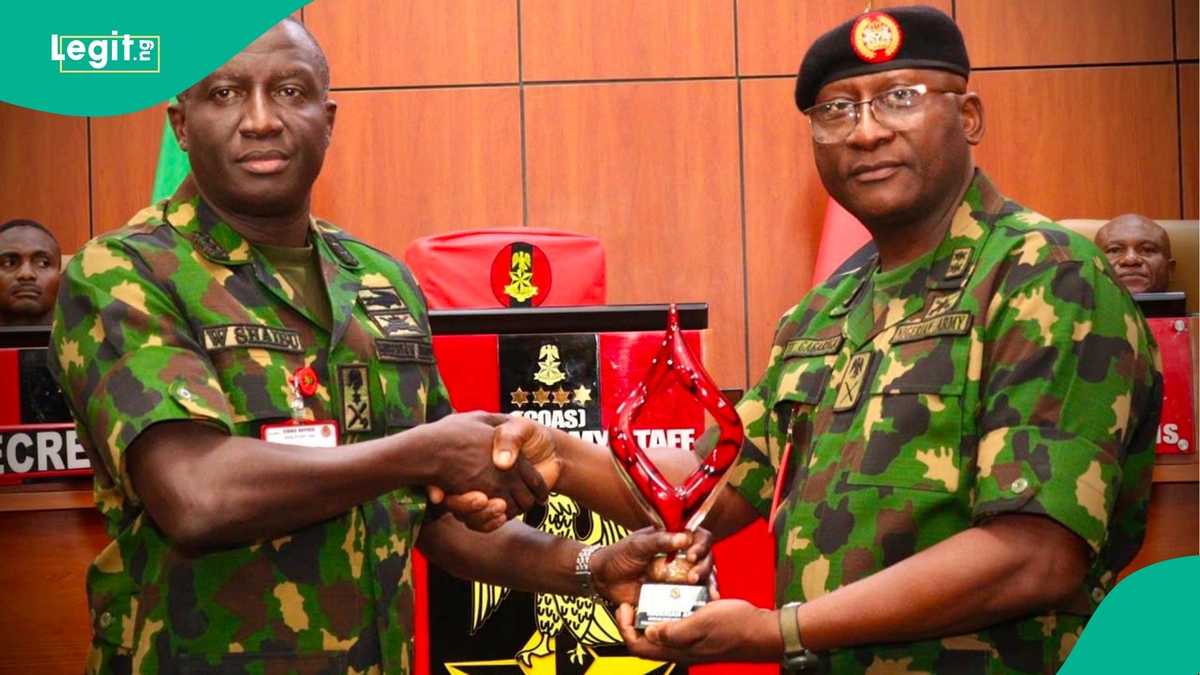
The Nigerian Army has been awarded a significant continental honour, named Africa’s Best National Army in Counter-Terrorism Operations for 2025 by African Security Watch, a continental security organisation that monitors and evaluates military performance across the region. The award was formally presented to Chief of Army Staff Lieutenant General Waidi Shaibu at Army Headquarters in Abuja on Wednesday, 29 July 2026, completing a process that had begun with the original ceremony held in Banjul, The Gambia, where Major General Teriworie Gagariga received the award on behalf of the force.
African Security Watch grounded its decision in a clear assessment of operational performance rather than ceremony or sentiment. The organisation pointed to the army’s coordinated joint operations, its intelligence-driven campaigns against terrorist networks, effective civil-military cooperation on the ground, and sustained investment in force development and capacity building. Taken together, these factors had, in the organisation’s view, measurably weakened terrorist organisations and improved security conditions both within Nigeria and across the wider region. The body went further, describing the Nigerian Army as a benchmark for professional excellence and operational effectiveness in counter-terrorism across the entire continent — a pointed statement that carries weight given the scale of security challenges facing multiple African nations simultaneously.
Lieutenant General Shaibu, receiving the award, was direct in where he placed the credit. He dedicated the recognition to the officers and soldiers who have lost their lives in active service, and to the families they left behind — a grounding acknowledgement that continental awards are ultimately built on individual sacrifice. He also framed the honour as a validation of the army’s evolving strategic approach. “The award validates the effectiveness of the Nigerian Army’s evolving counter-terrorism and counter-insurgency strategy and reinforces its position as a continental model for addressing complex security challenges,” he said. That is not a modest claim, but it is one the African Security Watch citation appears to support.
Looking ahead, the COAS outlined the army’s intended trajectory with reasonable specificity. Stronger intelligence-led operations, deeper collaboration with other domestic security agencies, rigorous training regimes, improved welfare for personnel, and the acquisition of modern equipment all featured in his remarks. These are not novel ambitions for a military leadership team, but the context matters: a force that has just been formally recognised as the continent’s leading counter-terrorism instrument has both the credibility and the obligation to back those words with results. The announcement was confirmed in an official statement signed by Colonel Appolonia Anele, Acting Director of Army Public Relations, on the same date.
This recognition arrives at a moment when Nigeria’s security architecture is undergoing broader structural change. President Bola Tinubu has already approved the establishment of four new Nigerian Army divisions as part of a major reorganisation, with Lieutenant General Shaibu subsequently approving the appointment of General Officers Commanding to lead each new formation. Whether that expansion translates into a more capable and responsive force — or simply a larger one — remains the question that Nigerians, not continental award bodies, will ultimately answer.