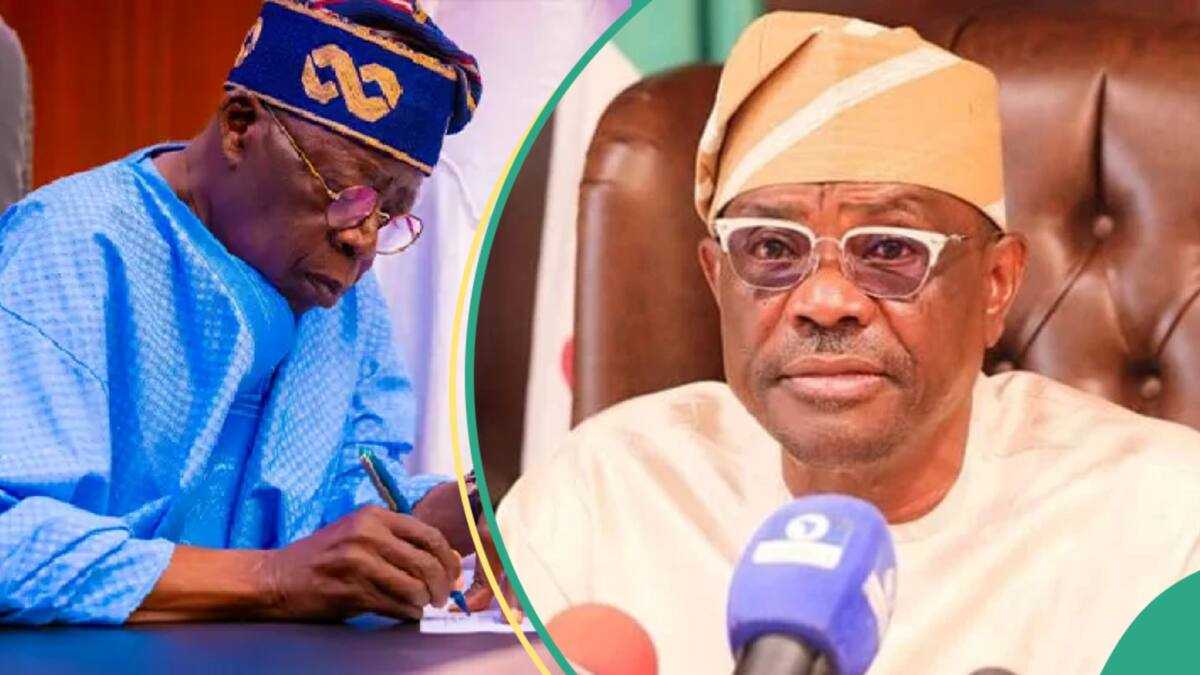
Nyesom Wike, the Federal Capital Territory Minister, launched his so-called Rainbow Coalition with considerable fanfare, presenting it as a broad, multi-party front to secure President Bola Tinubu’s re-election in 2027. The idea was straightforward: pull together figures from across the political spectrum — APC, PDP, Labour Party and beyond — and use that combined weight to make Tinubu’s second term look like a national consensus rather than a partisan project. It was an ambitious pitch. It is already falling apart.
Reports from Daily Trust dated 18 September 2026 confirm that both Labour Party figures in Rivers State and APC leadership across the South-East have publicly distanced themselves from the coalition, each for their own reasons. The cracks are not cosmetic. They go to the very heart of what the coalition claims to be.
Who actually represents Labour in this arrangement?
Senior Labour Party figures in Rivers State are flatly denying that the coalition speaks for their party. Favour Reuben, a former South-South Zonal Vice Chairman of the LP, says he has no connection to the alliance whatsoever, and goes further to allege that the LP governorship candidate the coalition is presenting is not actually a Labour Party member at all — but a PDP man. That is a serious charge. If true, it means the coalition is not so much a rainbow as a rebranding exercise, dressing up a narrow political arrangement in the language of inclusion.
Political analyst and Ogoni rights activist Celestine Akpobari made the same point with considerably more colour. “I have never seen a rainbow with one colour,” he said, pointing out that the APC chairman, the PDP chairman, and the governorship candidates of APC, PDP and Labour are all from the Ikwerre ethnic group. His criticism was direct: the coalition’s claim to inclusivity collapses the moment you look at who actually holds the positions within it. Akpobari also argued that if power is to move away from Governor Siminalayi Fubara — who hails from Rivers South-East — then the Ogoni people, who have never produced a governor, deputy governor, Speaker or Chief Judge in Rivers State, have the strongest moral claim to it. Calling the arrangement a form of dictatorship dressed up as coalition politics, he added: “A rainbow coalition cannot have one colour.”
Defenders of the coalition do exist. A Rivers APC chieftain, speaking anonymously, insisted that all local government chairmen and ward councillors are part of the alliance, and claimed that Governor Fubara himself has returned to the fold. Former Ijaw Youth Council president Udengs Eradiri, who ran as the LP governorship candidate in Bayelsa in 2023, also backed the arrangement, arguing it strengthens Tinubu’s re-election prospects precisely because it was built around the President rather than any individual governor’s ambitions. Whether these endorsements carry enough weight to offset the very public rejections is another question entirely.
The South-East APC is not having it either
Resistance to the coalition is not confined to Rivers State. APC leadership across the South-East — represented by National Vice Chairman Ijeomah Arodiogbu and state party chairmen from Abia, Anambra, Ebonyi, Enugu and Imo — issued a joint statement making their position unmistakable. They back the Progressive Governors’ Forum’s resolution to support only APC candidates in 2027, and they explicitly rejected what they called a “rainbow (chameleon) coalition”, warning that the party structure in the South-East would resist any outside effort to hollow out its base. The statement also defended the region’s governors, noting they had delivered visible development and helped deliver more than 25 per cent of the presidential vote in 2023 — a reminder that the South-East APC believes it has earned its standing and does not intend to be sidelined by a parallel structure operating outside the party’s formal channels.
Wike, for his part, remains publicly bullish. He has stated that his goal ahead of 2027 is to keep opposition figures — including former Vice President Atiku Abubakar and Labour’s Peter Obi — politically off-balance and under sustained pressure. He has also dismissed the current opposition as disorganised and leaderless, pointing to internal PDP divisions as evidence that Tinubu faces no credible challenger. That may well be true. But a coalition that cannot hold together its own claimed members, that faces ethnic exclusion charges from within Rivers State, and that the South-East APC has formally rejected, is not yet the formidable political machine its architect is describing. The 2027 election remains some distance away, but the Rainbow Coalition’s troubles are already very much in the present tense.