
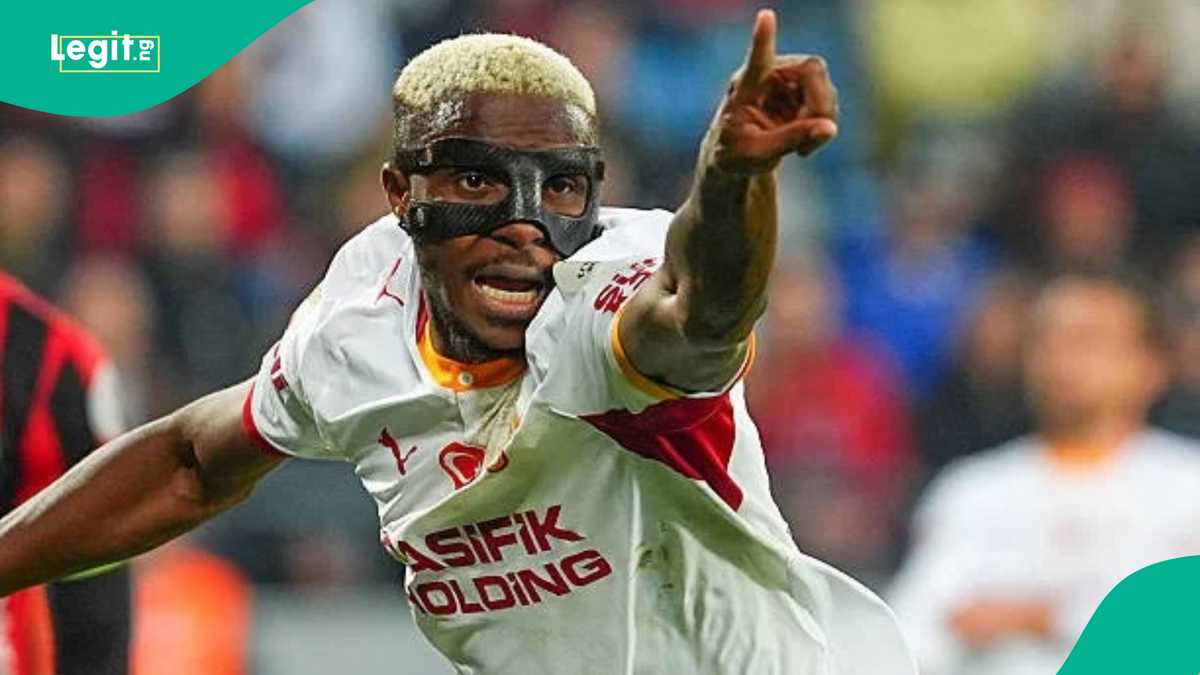
A Costly Groin and a Confidence Gap
It began in September, during what looked like a routine Süper Lig fixture. Galatasaray were beating İstanbul Başakşehir 3-2 when Victor Osimhen picked up a groin strain that would set in motion a sequence of events now drawing serious scrutiny from Turkish football pundits. The injury itself was not catastrophic, but its timing and its aftermath have raised uncomfortable questions about where exactly Nigeria’s most celebrated striker currently stands — physically, mentally and in terms of raw form.
The groin problem ruled Osimhen out of three consecutive club fixtures against Kocaelispor, Trabzonspor and Sporting Lisbon in the UEFA Champions League, a run of matches in which Galatasaray could have done with his firepower. More significantly for Nigerian football supporters, it also removed him from the Super Eagles’ 2027 Africa Cup of Nations qualifying campaign, forcing the coaching staff to call up Coventry City forward Taiwo Awoniyi as a replacement for the Guinea-Bissau and Madagascar fixtures. Nigeria managed without him, but the absence of their talisman was felt.
The Return That Did Not Quite Convince
When Osimhen came back after the international break, slotting into Galatasaray’s 3-1 league win over Kasımpaşa, there was reason for cautious optimism. He contributed an assist, the team won comfortably, and the narrative briefly pointed towards a smooth return to fitness. That optimism, however, did not survive the following week. In Galatasaray’s Champions League encounter against Barcelona, Osimhen struggled to impose himself in any meaningful way, and the brief flicker of his old authority against Kasımpaşa appeared to have been just that — a flicker.
The match against Gençlerbirliği made things starker still. Osimhen played the full ninety minutes and produced nothing — no goal, no assist, no decisive contribution of any kind. It was the first time this season that he had gone an entire league match without a goal involvement, and it extended his scoreless run to three consecutive games since returning from injury. According to Transfermarkt data, his tally remains fixed at six goals for the season, exactly where it stood when he limped off in September. The counter has not moved.
Uygun Speaks Plainly
Into this atmosphere of growing unease stepped Bülent Uygun, the former Fenerbahce and Sivasspor manager, speaking to Tivibu Spor in remarks subsequently reported by Habersarikirmizi. Uygun did not mince his words. He identified two distinct problems: a physical one rooted in the injury itself, and a psychological one manifesting in Osimhen’s behaviour on the pitch. “His desire to do a lot after his injury, coupled with his body’s lack of coordination, and his tendency to yell at his teammates after numerous mistakes, even his own, shows he’s still not ready,” Uygun said, offering the sort of blunt assessment that Turkish football commentary rarely shies away from.
Uygun went further, pointing to something specific and technical in Osimhen’s movement patterns. “Even in the chances he got, he struggled to maintain his footwork in 4-5 steps,” he observed, suggesting that the Nigerian has not yet recovered the explosive, instinctive rhythm that made him so dangerous at Napoli and in his early Galatasaray appearances. The former manager was careful to attribute this to the injury rather than any deeper failing, but the distinction provides only limited comfort — because the question of when, rather than whether, Osimhen will recover that rhythm remains unanswered.
A Pattern of Frustration Emerging
Uygun is not alone in his concerns. Before his intervention, former Galatasaray forward Necati Ateş had already gone public with criticism following the Gençlerbirliği match, questioning both Osimhen’s body language when he fails to score and his decision-making in front of goal — specifically his apparent preference for shooting in situations where a pass to a better-placed teammate would have been the sharper choice. These are not the observations of peripheral figures speaking out of turn; they are assessments from men who understand the demands of Turkish football at the highest level, and they are converging on the same uncomfortable conclusion.
What makes this particularly significant is the broader context of Osimhen’s career trajectory. He arrived at Galatasaray on loan from Napoli carrying the weight of being the 2023 African Player of the Year and one of the most lethal centre-forwards in European football. The expectation was that he would be a transformative presence in the Süper Lig and a credible force in the Champions League. For stretches of the season, he delivered on that billing. The six goals he scored before the injury were not negligible. But the version of Osimhen that Turkish football is currently watching — frustrated, physically off-kilter, unable to maintain his footwork through a simple five-step sequence — bears too little resemblance to the one that terrorised Serie A defences.
What This Means for Nigeria
For Super Eagles supporters and the team’s technical staff, the situation demands honest attention rather than reflexive reassurance. Osimhen is twenty-seven years old, an age at which most elite strikers are at or near the apex of their powers, and the AFCON qualifying campaign will continue to demand his best. Taiwo Awoniyi proved a capable deputy during the Guinea-Bissau and Madagascar games, but Nigeria’s ambitions for 2027 are built, in no small part, around having a fully fit and fully sharp Osimhen leading the attack. A striker who is yelling at teammates, misfiring in front of goal and struggling with basic physical coordination is not that player — not yet, at any rate.
Uygun’s prognosis is that time and patience are the primary remedies, and that the groin injury remains the root cause of everything currently going wrong. That is a reasonable medical position, and it leaves room for optimism. Galatasaray’s domestic and European schedule will continue to offer Osimhen opportunities to silence the critics and rediscover his sharpness. But the evidence of the past three matches suggests that the road back to his peak is longer than a single assist against Kasımpaşa might have implied, and Nigerian football cannot afford to look away from that reality.